How to play Cambio
Rules and winning strategy for Cactus, Pablo, Dutch and four-card golf
Four hidden cards, two brief peeks and one goal: finish with the lowest hand. Learn the complete rules, then the strategy that separates lucky calls from winning ones.


What is Cambio?
Cambio is a memory card game where every player holds four face-down cards and tries to finish with the lowest total. It is played around the world under names including Cactus, Pablo, Dutch and four-card golf.
Setup
Deal four cards face down to each player in a 2×2 grid. Each player may look at two of their cards once, then must remember them. Turn one card face up to begin the discard pile.
Card values
Jokers score 0, aces 1, cards 2–10 their face value, jacks 11, queens 12 and kings 13. The lowest total wins.
On your turn
Draw the top card from the deck or take the top discard. Swap it with one of your face-down cards without looking at the card you replace, or discard the card you drew.
Power cards
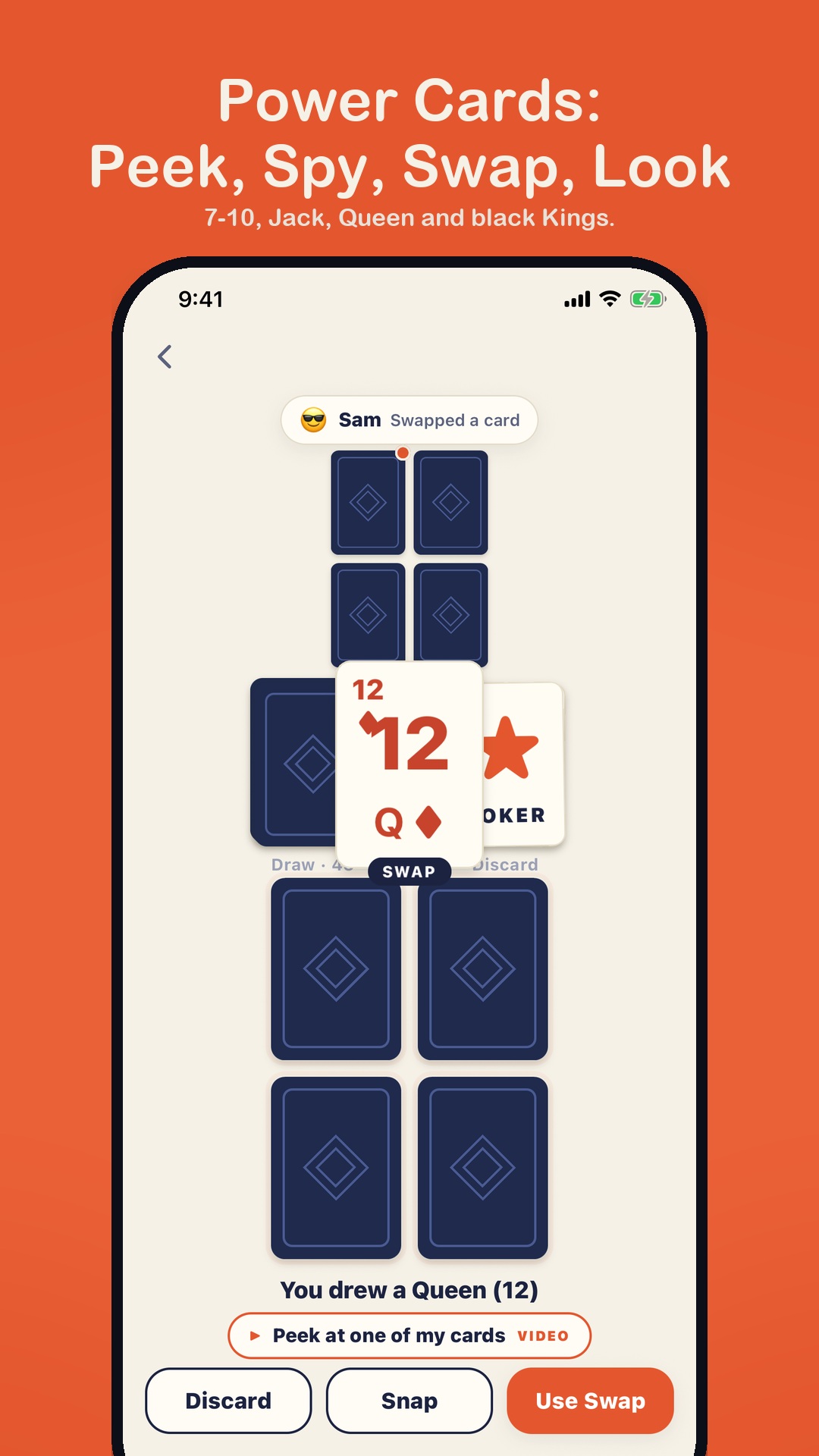
A 7 or 8 lets you peek at one of your cards. A 9 or 10 lets you spy on one opponent card. A jack or queen lets you swap any two cards on the table without looking. A power works only when you discard a card you just drew.
Matching pairs
If you are certain two of your cards have the same rank, discard both and put your new card in their place. Your hand becomes smaller.
Calling Cambio
Call at the start of your turn when you believe you have the lowest total. Everyone else gets one final turn, then all cards are revealed. Lowest total wins; if the caller ties for lowest, the caller loses.
Card values at a glance
Keep
Joker, A, 2, 3
0–3 points
Neutral
4, 5, 6
4–6 points
Power
7–8 peek · 9–10 spy · J–Q swap
use on discard
Dump
King and other high cards
11–13 points
Cambio strategy: how to win more often
1. Know what a good card is
With jokers included, the average card is worth about 6.7 points. Treat 0–3 as cards to keep, 4–6 as neutral and 9–13 as cards to get rid of. A typical opening four-card hand totals around 26, so anything under 10 is a strong hand.
2. Open with a plan
Peek at your two cards and remember their positions. If one is high, it becomes your first replacement target. Your two unseen cards are unknown risks: use early 7s and 8s to look at them before trading blindly.
3. Swap with purpose
Only replace a card you know is high, or an unknown card with something very low (0–2). Swapping a known 6 for a drawn 5 saves little and wastes a turn you could use on a power. Take a low discard immediately — your opponents can see it too.
4. Use powers at the right time
Peek (7–8) is strongest early, while your own hand is still a mystery. Spy (9–10) becomes stronger late, when you need to judge whether an opponent is close to calling. Blind swap (J–Q) is your weapon against a leader: give your known high card to the player you think is lowest.
5. Track the table
Remember what each opponent swaps away and what they keep. A player who discards a 9 from an unknown slot probably holds something lower there now. If they take a low discard, they hold at least one card you know.
6. Match only when certain
Matching shrinks your hand and can drop several points at once, but a wrong guess usually costs a penalty card. Match pairs you have actually seen, not ones you think you remember.
7. Call at the right moment
Call when your known total is low and you have few unknown cards — roughly 8 or less is a confident call in a typical game. Because ties go against the caller, leave yourself a margin. Every opponent still gets one more turn after you call.
8. Defend against a caller
When someone calls, use your final turn to lower your own total as far as possible. A jack or queen swap that hands the caller your highest known card can turn their win into a loss.
Example hand, turn by turn
- StartYou peek at a 2 and a king (13). Two cards are unknown.15 known + 2 unknown
- Turn 1You draw a 7 and discard it to peek: an unknown card is a 4.19 known + 1 unknown
- Turn 2You draw an ace and swap out the king.7 known + 1 unknown
- Turn 3You draw an 8 and peek at your last card: a 3.10, all four seen
- DecisionWith 10 points and nothing hidden, wait one more turn for a low card — or call now if an opponent looks close.Call with confidence
Common mistakes
- Forgetting which position each card sits in after a swap.
- Swapping a power card into your hand instead of discarding it for its effect.
- Calling with two unknown cards because the known ones look good.
- Ignoring the discard pile — it tells you what everyone has given away.
- Guessing at matches and collecting penalty cards.
Frequently asked questions
Is Cambio the same as Cactus, Pablo and Dutch?
Yes. They are regional names for essentially the same game, although small house-rule details can differ.
Is it like four-card golf?
It is a close cousin of four-card golf, with memory, power cards and the decisive Cambio call.
How many people can play?
Two to four players works best.
What is a good score to call Cambio?
Around 8 or less with no unknown cards is usually strong. Be more careful against experienced players, and remember a tie goes against the caller.
Should I always use a power card?
Not always. Peek when you have unknown cards, spy when you need information about a possible caller, and swap when you can hand a high card to the leader.
Practise your strategy in Flipfold: Cambio Card Game
Play free against the computer, take the daily challenge or invite friends with a five-letter code.