How to play Dots and Boxes
Remember the game in the back of your school notebook? Draw lines, close squares and win more boxes than your opponent. Here are the rules—and the chain trick that changes how you play.
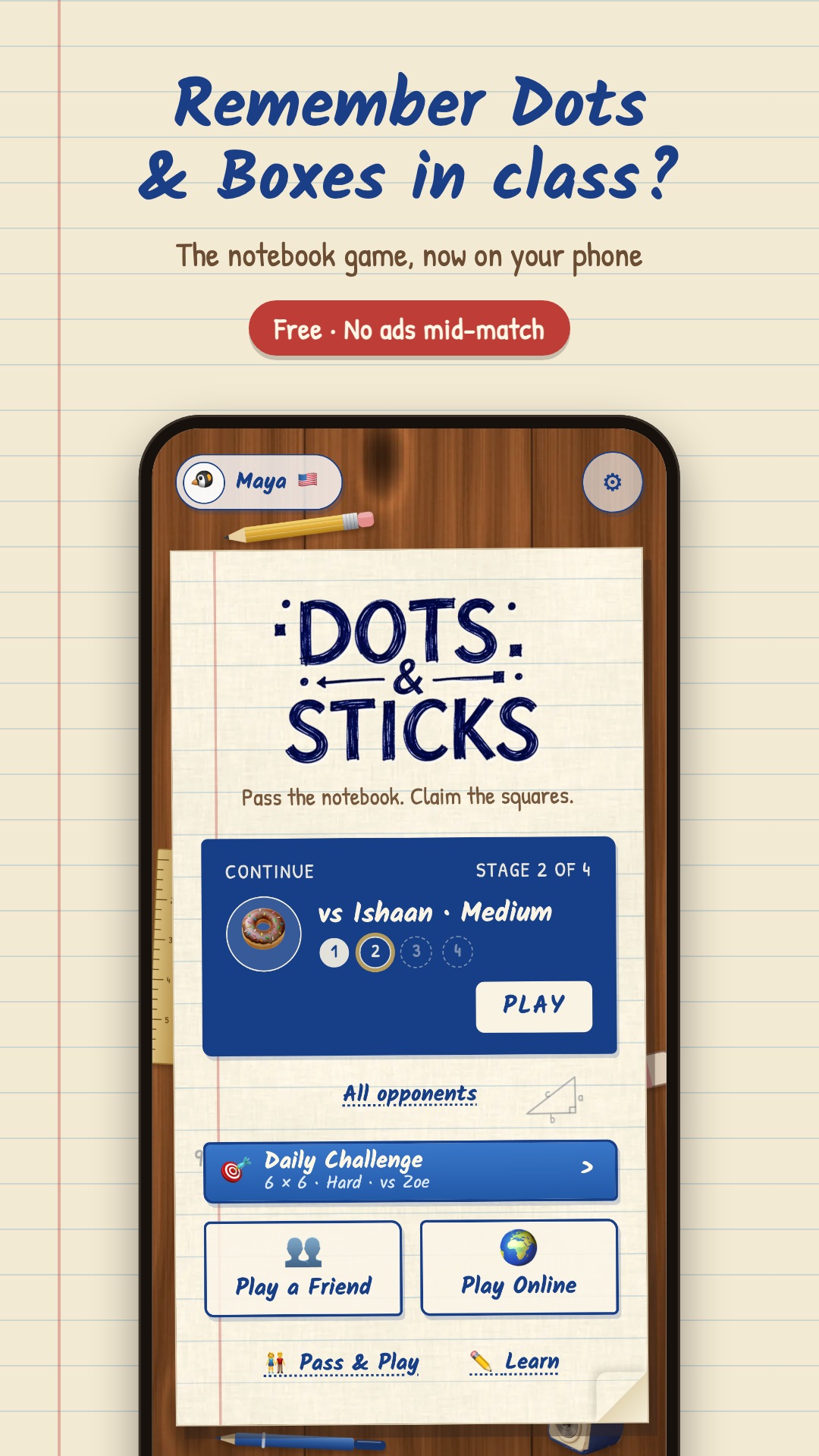
Play it free on your phone with Dots and Boxes: Online & AI.
What you need
Two players, a pen each and a grid of dots. A small 4×4 dot grid is quick; larger grids create longer chains and more tactical games.
Taking a turn
Draw one horizontal or vertical line between two neighbouring dots. Diagonal lines are not allowed. Then the other player draws one line.
Claiming a box
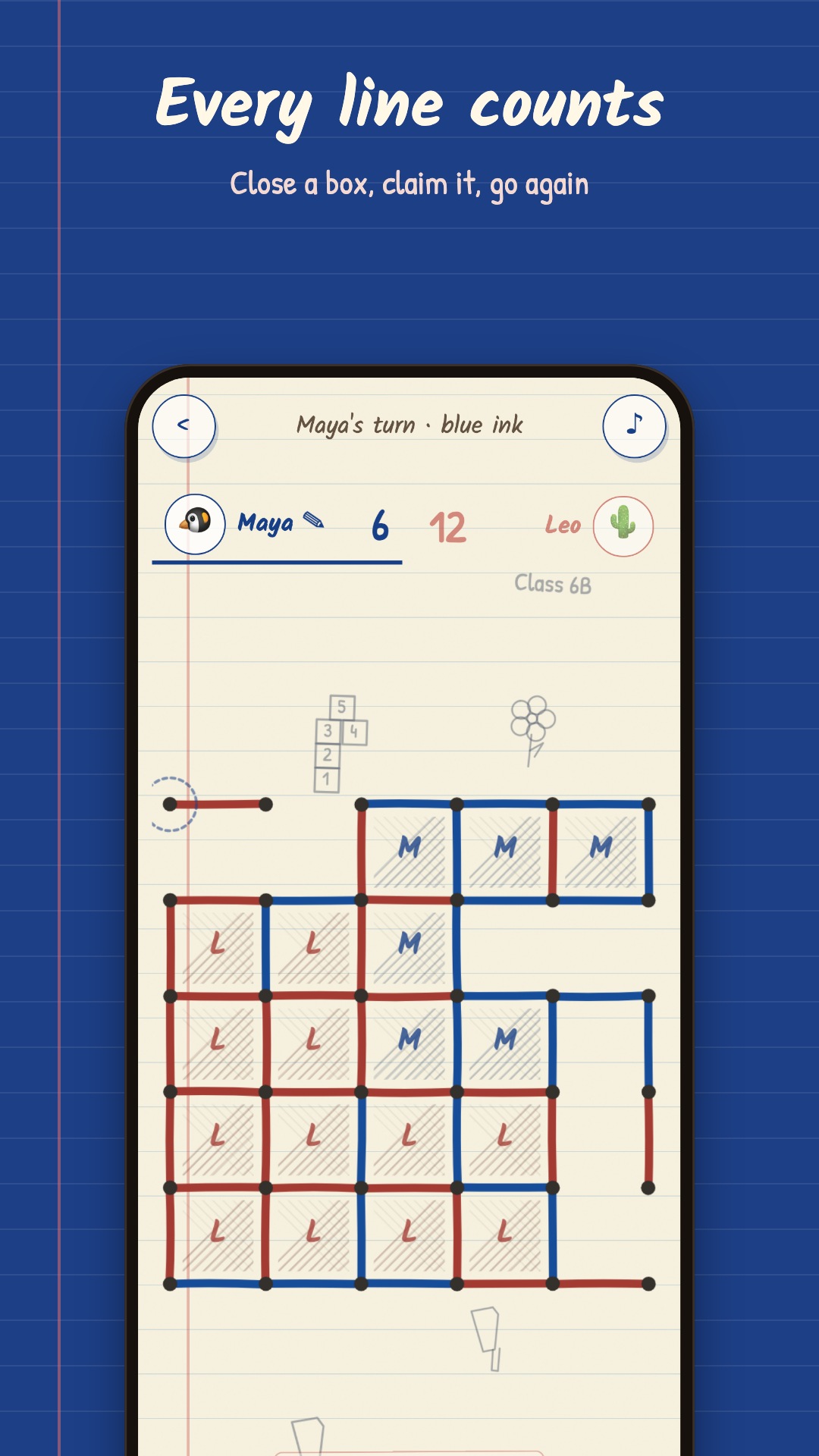
Complete the fourth side of a square to claim it. Mark the box with your initial or colour, then immediately take another turn. You keep playing while every new line completes a box.
How the game ends
The game ends when every possible line has been drawn. Count the claimed boxes; the player with the most wins.
Chains
A chain is a run of boxes with two sides already drawn. Opening a long chain can hand many boxes to your opponent. Most strategy comes from deciding when a chain must be opened.
Closed loops
A loop is a chain whose ends join back together, so it has no open end. When you hand over a loop, you usually give away four boxes rather than two if you want to keep control—loops cost more to sacrifice than open chains.
Counting chains in the endgame
When no safe moves remain, every move opens a chain or loop. Before that moment, count the long chains (three boxes or more). Whoever is forced to open the first long chain usually loses control, so spend the middle game steering the count in your favour and leave short chains for your opponent to open.
Common mistakes
Drawing the third side of a box too early, grabbing every box in a chain without checking what remains, and opening a long chain while a short one is still available are the three errors that decide most casual games.
Grid sizes and variations
Board size changes the feel: small grids are fast and tactical, while larger grids create more chains and longer endgames. Some players score extra for bigger boards or play on non-square grids, but the core rule never changes: complete a box, take another turn.
Simple strategy tips
Early on, avoid drawing the third side of a box. Watch for connected chains, and remember that giving away two boxes can sometimes force your opponent to open a much longer chain later.
How to win: leave two boxes to keep control
Taking every available box is not always the best move. If another unopened chain remains, you can sometimes give away the last two boxes of the current chain so your opponent must open the next one.
- In this three-box chain, capture the first box and take your extra turn.
- Instead of closing the middle box, draw the line at the far end. You score nothing on this move, so your turn ends.
- Your opponent can close the middle edge and claim both remaining boxes. Their extra turn then forces them to play elsewhere—potentially opening the next chain for you.
Use this only when the next chain is worth the sacrifice and no safe moves remain. If this is the last chain on the board, take all its boxes. Closed loops have a different handout pattern; this example is for an open chain.
Can you win every time?
No strategy guarantees a win against every opponent from every position. Avoid giving away a third side early, count the chains before the endgame, and practise deciding when to sacrifice boxes.
Dots and Boxes: Online & AI
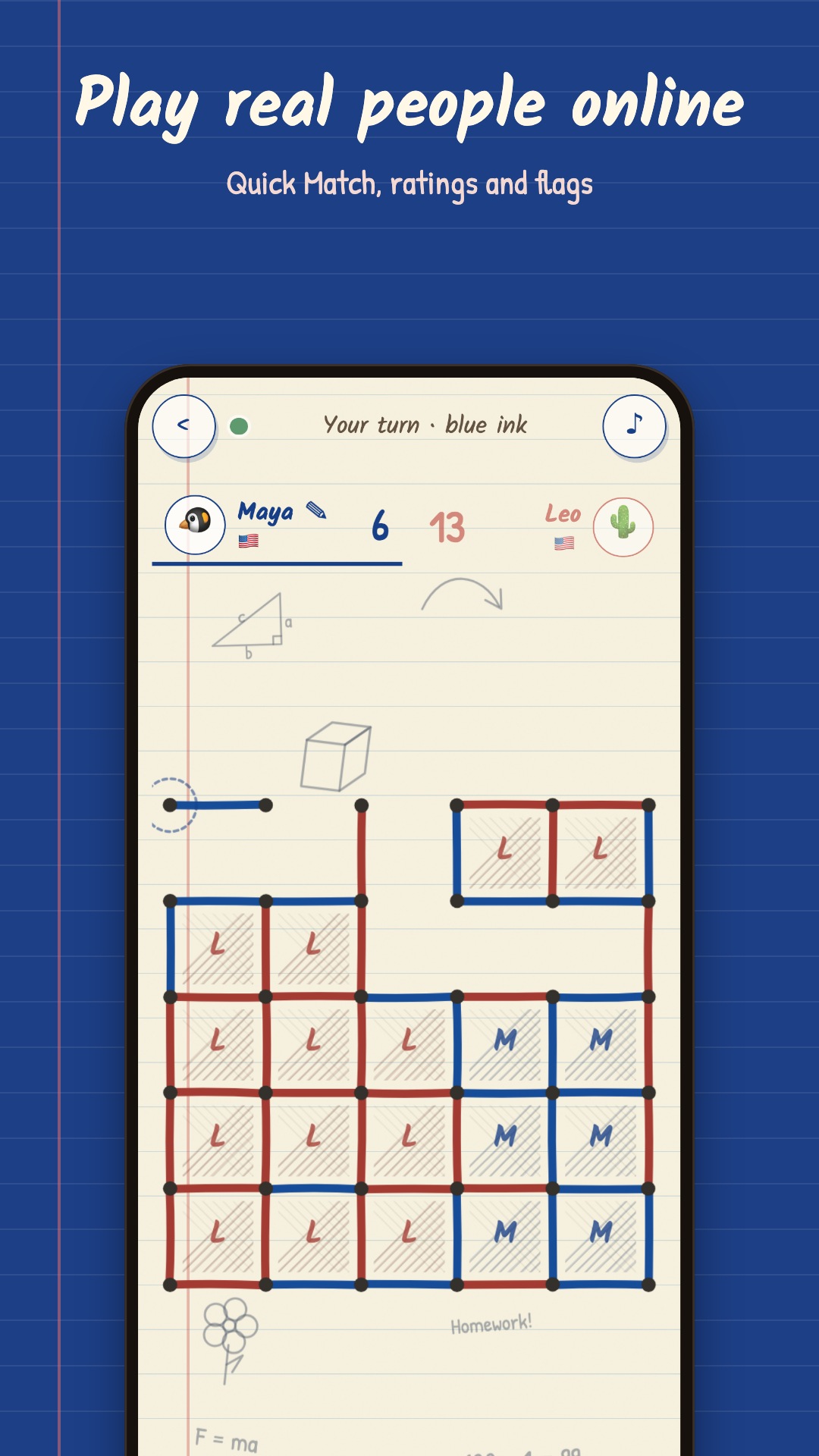
Challenge a friend online, practise against the computer, or take turns on one phone. Free on iPhone and Android, with no ads interrupting a match.