How to play Checkers
Checkers (called draughts in the UK) takes a minute to learn and a lifetime to master. This guide covers the standard American rules — setup, moves, compulsory jumps, multiple captures and kings — with diagrams, beginner strategy and answers to common questions.
Updated 23 November 2026 · 6 min read
Checkers rules in 30 seconds
- Each player puts 12 pieces on the dark squares of the three rows nearest them.
- Dark moves first, then players alternate.
- Move one piece diagonally forward to an empty dark square.
- Capture by jumping diagonally over an opponent’s piece into the empty square beyond. Captures are compulsory.
- If the same piece can jump again, keep jumping in the same turn.
- Reach the far row to become a king, which can move and capture backwards too.
- Win by taking all your opponent’s pieces or leaving them with no legal move.
How to set up a checkers board
Checkers is played on an 8×8 board of 64 alternating squares, but only the 32 dark squares are used. Turn the board so each player has a light square in the bottom-right corner.
Each player places 12 pieces on the dark squares of the three rows nearest them. The two middle rows start empty.
How pieces move
Players take turns moving one piece. An ordinary piece (a “man”) moves one square diagonally forward onto an empty dark square. It can never move sideways, straight ahead or backwards.
Jumping and multiple captures
To capture, jump diagonally over an opponent’s piece that sits right next to you, landing on the empty square directly beyond it. Remove the captured piece from the board.
If your piece can jump again from where it lands, it must keep jumping in the same turn — this is a double or triple jump. Captures are compulsory: if any jump is available, you have to take one.
When several captures are possible, you may choose any of them — you don’t have to pick the one that takes the most pieces.
Kings: reaching the far side
When a piece reaches the far row, it is crowned a king — stack a captured piece on top. Being crowned ends your turn.
Kings move one square diagonally in any direction and can capture forwards and backwards, which makes them far more powerful than ordinary pieces.
How to win (and when it’s a draw)
You win when your opponent has no pieces left or no legal move — for example, every remaining piece is blocked.
If neither player can make progress — often one king each — the game is a draw.
Checkers strategy: 7 tips for beginners
- Control the centre. Pieces in the middle of the board have more moves and restrict your opponent.
- Guard your back row. Keeping a couple of pieces home for as long as possible stops your opponent getting kings.
- Move in pairs. A piece with a friend diagonally behind it can’t be jumped from the front.
- Use forced captures against your opponent. Because jumps are compulsory, offering one piece can drag an enemy piece into a spot where you jump two back.
- Look one move further. Before every capture, check where your piece lands and whether it can be jumped straight back.
- Edges are safe but slow. A piece on the side can’t be jumped, but it only has one move forward.
- Trade when you’re ahead. Swapping one piece for one piece makes a lead easier to convert in the endgame.
Practise these against the computer on Easy, Medium or Hard in Board Hub.
Common beginner mistakes
- Forgetting that jumps are compulsory — and walking into a forced capture.
- Stopping after one jump when a second jump is available.
- Emptying the back row early and letting your opponent crown kings.
- Moving ordinary pieces backwards — only kings can.
Checkers variations around the world
- American checkers / English draughts — the 8×8 rules on this page.
- International draughts — a 10×10 board with 20 pieces each. Ordinary pieces may capture backwards, kings fly any distance along a diagonal, and you must take the largest available capture.
- Russian and Brazilian draughts — 8×8 boards that use flying kings and allow ordinary pieces to capture backwards.
Chinese checkers is not a variant — it’s a different racing game played on a star-shaped board.
Checkers FAQ
How many pieces does each player have in checkers?
- Twelve each, 24 in total. They start on the dark squares of the three rows closest to each player.
How do you set up a checkers board?
- Turn the board so each player has a light square in their bottom-right corner. Then place your 12 pieces on the dark squares of your first three rows, leaving the two middle rows empty.
Who goes first in checkers?
- In standard American checkers the darker side moves first. Many family sets use red and black pieces and house rules vary, so agree before you start and alternate in the next game.
Do you have to jump in checkers?
- Yes, in standard rules. If a capture is available you must take it. If several captures are possible you may choose which one, but you must finish all jumps with that piece.
Can regular pieces move or jump backwards?
- No. In American checkers ordinary pieces only move and capture forwards. Only kings move and capture in both directions.
What happens when a piece becomes a king?
- Crown it by stacking a captured piece on top. Reaching the king row ends that turn, even if the new king could jump again. From the next turn it can move diagonally forwards or backwards.
Can a king move more than one square?
- Not in American checkers — a king moves one square at a time (or jumps). In international draughts and some other versions, kings can fly any distance along a diagonal.
Can a checkers game end in a draw?
- Yes. If neither player can force a win, for example one king each, players agree a draw. Tournament rules add a limit on moves without progress.
Is checkers the same as draughts?
- Yes — “draughts” is the British name for the same 8×8 game. International draughts is a separate, larger 10×10 version.
Is checkers the same as Chinese checkers?
- No. Chinese checkers is played on a star-shaped board with marbles, and nobody captures — you race your pieces to the opposite point of the star.
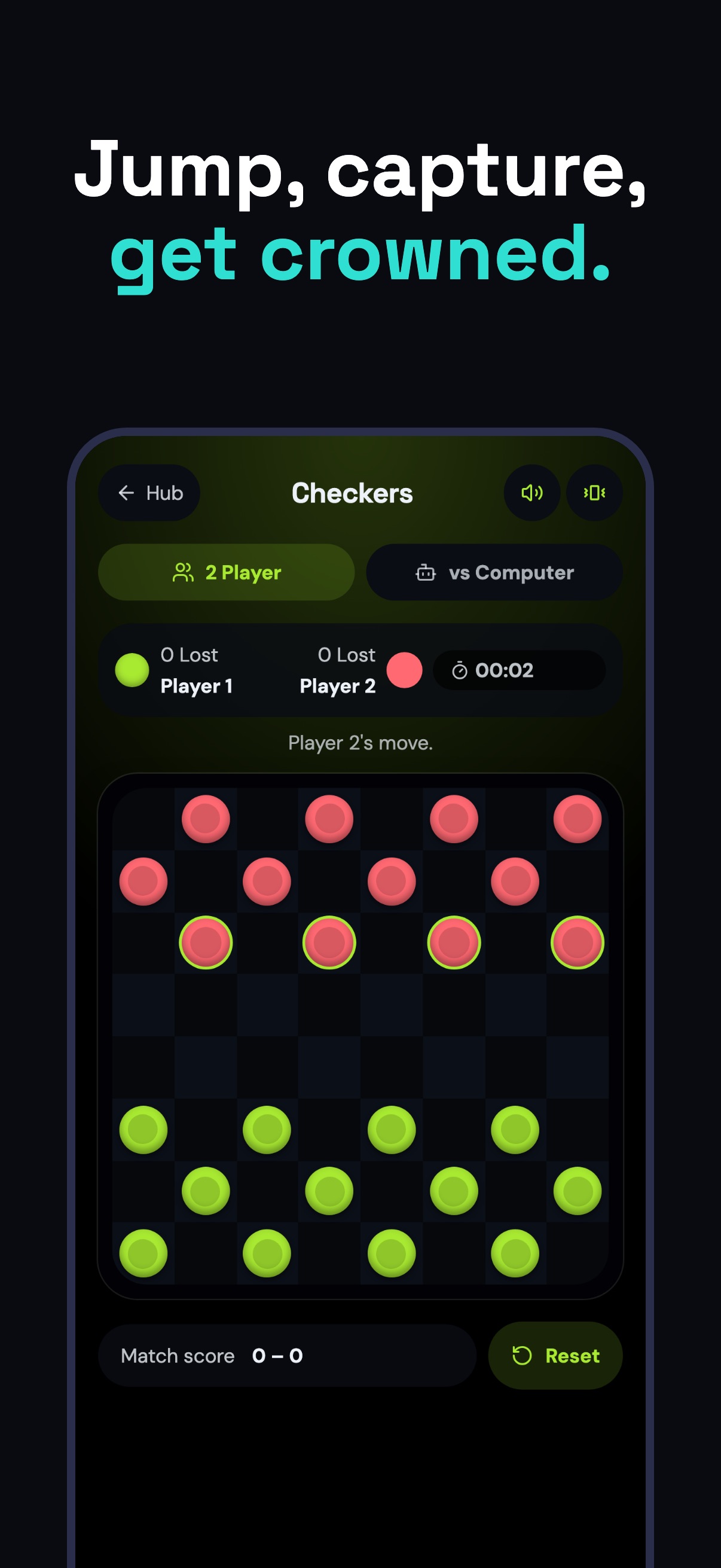
Play Checkers for free on your phone
2 Player Board Games Offline (Board Hub) has Checkers with jumps, captures and kings — pass the phone to a friend or play the computer on three levels. Also includes Mancala, Ludo and Four in a Row. No wifi, no sign-up.