How to play Mancala
Mancala is one of the oldest board games in the world, and you can learn it in five minutes. This guide covers the classic rules (often called Kalah), with diagrams for every move, beginner strategy and answers to the questions people ask most.
Updated 23 November 2026 · 6 min read
Mancala rules in 30 seconds
- Put 4 seeds in each of the 12 small pits. Both stores start empty.
- On your turn, pick up all seeds from one pit on your side.
- Moving counter-clockwise, drop one seed in each pit — including your own store, but never your opponent’s.
- If your last seed lands in your store, take another turn.
- If your last seed lands in an empty pit on your side, capture it plus every seed in the pit opposite.
- When one side is empty, the game ends. The other player banks the seeds left on their side. Most seeds wins.
The Mancala board
A Mancala board has two rows of six small pits and a large pit at each end called a store (or mancala). You own the six pits closest to you and the store on your right. Your opponent owns the far row and the store on their right — your left.
You only ever pick up seeds from your own row, and only the seeds in your store count at the end.
How to set up Mancala
Place four seeds (stones, beads or marbles all work) in each small pit — 48 in total. Leave both stores empty. Flip a coin to decide who goes first and swap for the next game.
Taking a turn: sowing seeds
Pick up all the seeds from any one non-empty pit on your side. Moving counter-clockwise — to the right along your row — drop one seed in each pit you pass. This is called sowing.
When you reach your store, drop a seed in it too, then continue along your opponent’s row. If you go far enough to reach your opponent’s store, skip it.
Free turns: land in your store
If the last seed you sow lands in your own store, you immediately take another turn. You can chain several free turns in a row.
The counting trick: number your pits 1 to 6 starting next to your store. A pit earns a free turn when it holds exactly that many seeds — 1 seed in pit 1, 2 seeds in pit 2, and so on.
How captures work in Mancala
If your last seed lands in an empty pit on your own side, you capture it together with every seed in your opponent’s pit directly opposite. Put them all in your store.
Landing in an empty pit on your opponent’s side does nothing — your turn simply ends.
How Mancala ends and who wins
The game ends as soon as all six pits on one side are empty. The other player moves every seed still on their side into their own store.
Count the stores — the most seeds wins. With 48 seeds, 25 guarantees victory and 24–24 is a draw.
Mancala strategy: 7 tips to win more
- Open with the third pit. From the standard setup it lands in your store for a free turn — the strongest first move for most players.
- Take free turns before anything else, starting with the pit closest to your store so you don’t spoil the others’ counts.
- Keep an empty pit ready. An empty pit on your side facing a big pile is a capture waiting to happen.
- Defend your piles. Before each move, check whether your opponent can land in an empty pit opposite your largest pile — if so, move or split it.
- Don’t feed your opponent. Big moves that sow lots of seeds into their row give them more options and more to capture back.
- Hoard on the right late in the game. Seeds kept in the pits nearest your store stay on your side; when your opponent runs out, you bank them all.
- Count to 25. Once you are close, play safe moves that keep seeds on your side rather than chasing captures.
Practise these against the computer on Easy, Medium or Hard in Board Hub.
Popular Mancala variations
Mancala is a family of games rather than a single rulebook. The rules above are Kalah, the version on most store-bought boards in the US and UK. Other well-known members include:
- Oware (West Africa and the Caribbean) — two rows of six pits, no seeds go into stores while sowing, and you capture from your opponent’s row when your last seed makes a pit total of two or three.
- Bao (East Africa) — a demanding four-row version with more complex sowing rules.
- Congkak (Malaysia, Indonesia and nearby) — seven pits per side and, traditionally, both players start sowing at the same time.
Quick house rules you may meet: starting with 3 or 5 seeds per pit, and whether a capture needs seeds in the opposite pit.
A short history of Mancala
The word mancala is usually traced to the Arabic naqala, “to move”. Count-and-capture games like it have been played across Africa, the Middle East and Asia for many centuries; boards carved into stone have been found at sites in East Africa that are well over a thousand years old.
Kalah — the simplified version taught here — was popularised in the United States in the mid-20th century and is why “Mancala” in the West now usually means two rows of six pits and two stores.
Mancala FAQ
How many stones go in each Mancala pit?
- Four in each of the 12 small pits, so 48 seeds in total. Some families use three per pit for a faster game or five or six for a longer one — just agree before you start.
Do you put a seed in your opponent’s store?
- No. When sowing you drop seeds into your own store but always skip your opponent’s store.
Which way do you move in Mancala?
- Counter-clockwise: along your own row towards your store, then back along your opponent’s row.
What happens when one side runs out of seeds?
- The game ends straight away. The player who still has seeds on their side moves them all into their own store, then both stores are counted.
Can you go all the way around the board?
- Yes. A pit with lots of seeds can lap the board. With 13 seeds your last seed lands back in the pit you started from — which is now an empty pit on your side, so it captures.
Can you capture from an empty opposite pit?
- Rules vary. Some tables allow it, so you capture just your one seed; others say the capture only counts if the opposite pit has seeds. Pick one rule before the game.
How many seeds do you need to win?
- With 48 seeds, 25 in your store guarantees a win. A 24–24 finish is a draw.
Is Mancala luck or skill?
- Pure skill. There are no dice or hidden cards — both players see every seed, so counting ahead decides most games.
How many players can play Mancala?
- Two. Each player owns one row of six pits and the store on their right.
What is the difference between Mancala and Kalah?
- Mancala is the name of the whole family of seed-sowing games. Kalah is one member of it — and the version most people mean when they say “Mancala” in the US and UK.
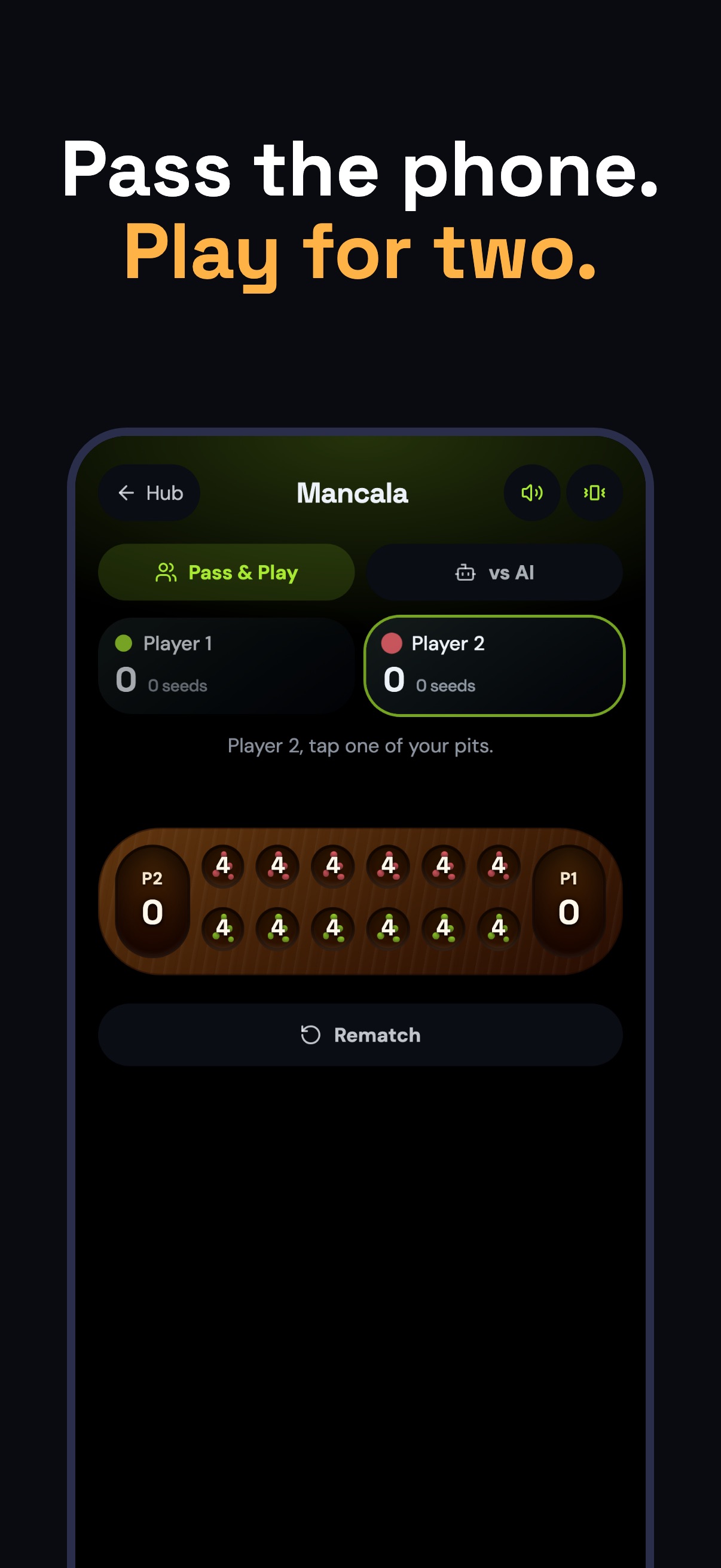
Play Mancala for free on your phone
2 Player Board Games Offline (Board Hub) has Mancala for two players on one phone, or against the computer on three levels — plus Checkers, Ludo and Four in a Row. No wifi, no sign-up.